
Rescue

⚡ 48 HOURS IN HELL — THE RESCUE THAT DEFIED A NATION ⚡

There are missions that live in briefings…
And then there are missions that become legend.

This was the latter.

A 48-hour window where time stopped meaning anything. Where survival came down to instinct, training, and sheer refusal to be captured. Where the line between life and death was measured in seconds, altitude, and silence.


🔥 APRIL 3 — IMPACT AT MACH SPEED

It starts violently.

An F-15E Strike Eagle, deep over southwestern Iran, is engaged.
No warning long enough to react. No margin to escape.

A high-speed missile—estimated Mach 2.8—closes the distance.
Not a direct hit. Worse.

💥 Proximity fuse detonation.

The blast tears through the airframe, shredding systems, ripping control authority apart. The jet is no longer a machine—it’s debris still moving forward.

Two men. One decision.

EJECT.


🪂 HOUR 0 — SEPARATION

Both crew punch out into hostile territory.

The pilot lands closer to friendly reach and is recovered quickly.

The Weapon Systems Officer (WSO)… drifts farther.

Alone. Silent. Invisible.

Enemy territory in every direction.

No support. No cover. No guarantee.


🌑 HOURS 1–12 — THE HUNT BEGINS

The moment boots hit the ground, the clock starts ticking.

The WSO moves immediately—no hesitation.
Training takes over. Survival becomes rhythm.

But Iran reacts fast.

🚨 IRGC units deploy within hours.
🚨 Search grids expand.
🚨 Thousands of civilians mobilized.

This isn’t just a search.

It’s a manhunt across an entire region.

Every ridge, every road, every village becomes a risk.

The WSO doesn’t run randomly.
He thinks, calculates, disappears.


⛰️ HOURS 12–24 — THE CLIMB

Fatigue sets in. Hydration drops. Adrenaline burns out.

Still… he climbs.

A brutal ascent to a 7,000-foot ridge—not for escape, but for survival.

Why climb?

Because elevation means:

Fewer patrol routes

Reduced civilian presence

Better observation

Harder capture

Below him, the situation escalates.

💣 US forces crater key roads to slow IRGC reinforcement.
Every destroyed route buys minutes.
Every minute keeps him free.


💥 HOURS 24–36 — THE COST RISES

Rescue operations intensify… and so does resistance.

An A-10 Warthog enters the fight—low, lethal, built for chaos.

But the sky is no longer safe.

🚀 Chinese MANPADS strike.
The A-10 goes down.

Now it’s not one survivor.

It’s more.

And the risk multiplies.

Meanwhile:

🚁 Two HH-60W rescue helicopters are hit.

These are not just aircraft.
They are lifelines.

And now even the lifelines are under fire.


🌌 HOURS 36–48 — THE NIGHT PUSH

There is only one option left:

🌑 Full-scale nighttime extraction.

No half-measures. No delays.

Everything moves under darkness:

Special operations teams

Rescue helicopters

Air cover layered above

The WSO holds position.
No lights. No signals beyond what’s necessary.

Every sound could betray him.
Every second could end it.

Then… movement.

Then… contact.

Then… confirmation.


🚁 APRIL 5 — EXTRACTION

In the early hours before dawn…

💬 “Package secured.”

The WSO is pulled out.

Alive.

Exhausted. Hunted. But unbroken.


🛡️ THE RESULT

Against overwhelming odds:

3 airmen

2 downed aircraft

48 hours behind enemy lines

➡️ All recovered. All alive. All out.


📊 THE BIGGER PICTURE

This wasn’t an isolated moment.

It unfolded within a wider conflict that has already seen:

✈️ 13,000 combat sorties flown

That number tells its own story—
Of scale. Of intensity. Of a sky that never truly sleeps.


⚖️ WHAT THIS REALLY MEANS

This mission wasn’t just about rescue.

It was about:

Trust between crew and command

Precision under pressure

The unspoken promise: no one gets left behind

In modern warfare, technology matters.
Speed matters. Firepower matters.

But in the end…

It still comes down to a single human being
moving through darkness,
choosing not to quit.


🔥 48 hours. One survivor. A nation searching. A team that refused to fail. 🔥
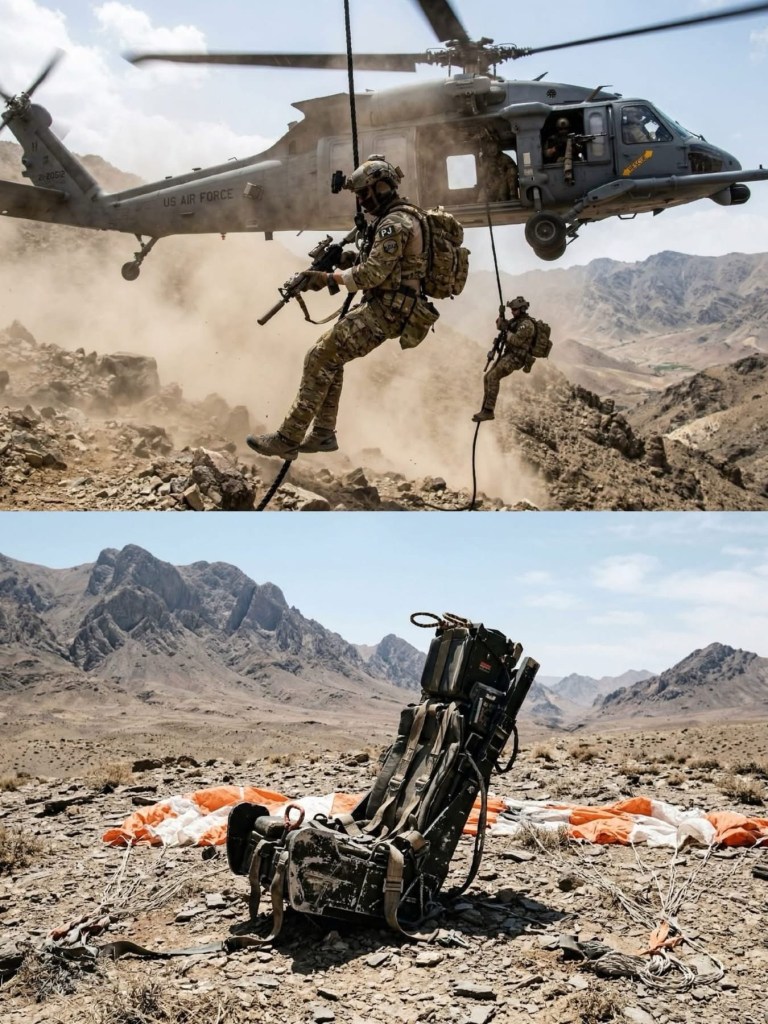
I am so proud to call myself an American. The strength and professionalism of our military is off the charts. God Bless the fighting men and women of our armed forces. God Bless the United States of America. Make America Godly Again! Rh

Update:
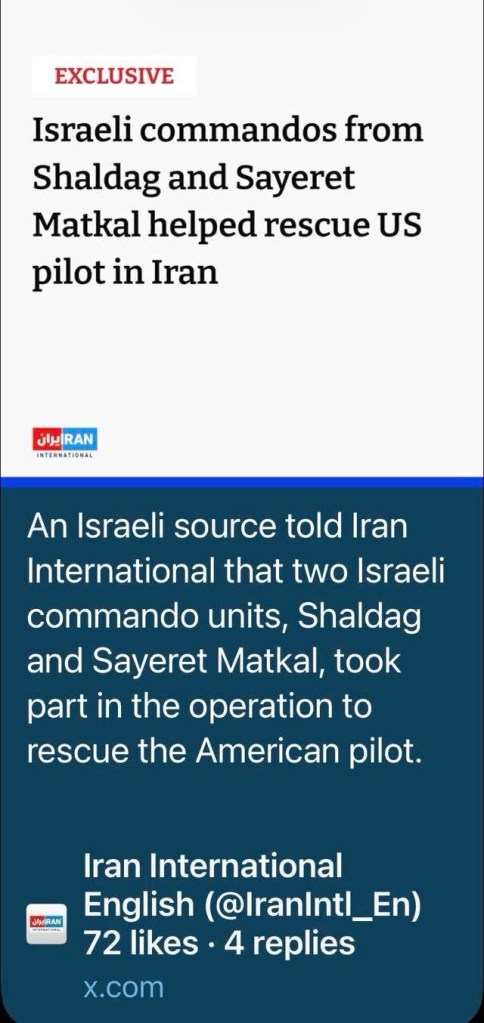
News Update. Iran

Things are changing so fast during this war.  This is going to be interesting to see how the regional alliances handle the defeat of Iran, especially while old friends, or at least friends that hated Israel, are now expelling old friends from their country.  Trump and Netanyahu have certainly turned the Middle East on its ear.  Even Turkey is telling Iran to be careful in targeting their country.  With victory in sight, if not already there, old cautious allies of Iran are turning like rats running off a sinking ship.  Good to see. Rh

The Qataris have reportedly delivered an eviction warning to the Hamas leadership in Doha. After Iran struck their former ally, Qatar asked their guests to condemn the attack. In a serious violation of guest etiquette, Hamas refused.

Before we get too excited, let me remind everyone that Qatar has threatened to do this before. Multiple reports said Hamas leaders left for Turkey after a Qatari directive in April 2024, and there were rumors of Doha “reconsidering” Hamas’s presence in November 2023; March, May and October of 2024; and a few times in 2025 as well.

Hamas doesn’t seem to have many options for relocation. They require certain qualities in a host: friendly to terror, immune to Israeli strikes and willing to accept the stigma of their presence. There is no shortage of countries in the region with an agnostic view of terrorism; far fewer that Israel wouldn’t strike. But that last factor seems to be the trickiest to find. Even Turkey—which has no problem discreetly supporting Hamas and is the most immune to Israeli strikes in the region—is hesitant to take the American heat that would come with allowing Hamas leaders to walk in through the front door.

The truth is, it’s a great deal for Qatar. For the price of a few hotel rooms, they get to be a key player in one of the world’s most important negotiations. They are America’s go-to terror mediators, so hosting Hamas is more expected than scandalous. Then again, now that all the hostages have returned, Hamas’s value has depreciated somewhat. Still, I put the odds at 60-40 that they stay.

Qatar may keep them around, but that doesn’t mean it will advocate on their behalf or give them money. Hamas leaders are reportedly terrified that, with Iran looking unreliable, the loss of Qatari support would be a devastating blow to the organization.

Israel’s perspective has always been that among the terror groups on its borders, Hezbollah was the one most likely to collapse with the loss of Iranian support. Hamas existed long before Iran’s patronage, and it was widely believed it would survive after the Islamic Republic’s fall. But the panic among its leaders indicates it might be easier to dismantle an independent Hamas than previously thought.

It would be remiss not to mention that Iran seems to be more effective than Israel at disposing of Hamas leaders. When Israel struck Doha last September, Hamas had to change hotels. When Iran struck Qatar, Hamas suddenly found itself homeless.

Deep beneath the ground near the Iranian city of Isfahan lies the ayatollahs’ treasure chest. Lead-lined, it contains Iran’s most valuable asset: more than 400 kilograms of 60 percent enriched uranium.

The world’s most radioactive buried treasure was entombed by the U.S. and Israel during the June war and is thought to be inaccessible without a large excavation effort. But according to a recent U.S. intelligence report, there remains a “very narrow access point” through which the Iranians—or the U.S.—could potentially retrieve the prize.

I’m not being playful when I say this is the treasure of the regime. It cost them hundreds of billions to create, and it is their most powerful weapon—though more in negotiations than in destructive potential. That makes it valuable to the U.S. and Israel as well: Take away the uranium and you remove a load-bearing beam in the regime’s infrastructure.

Fortunately, pulling up IRGC-branded moving trucks is not an option. The site is watched from above by the U.S. and Israel; any Iranian attempt at extraction would be met with an excessive amount of munitions.

An allied operation faces similar challenges. Four hundred kilograms of uranium doesn’t fit easily into a backpack. Any operation would require significant forces around the “very narrow access point” to repel what would likely be a substantial Iranian counterattack.

But Trump hasn’t ruled out sending in special forces, and rumors from both Israel and the U.S. indicate that such an operation is being considered.

Short of Trump walking into the presidential palace in Tehran, victory is a hard thing to photograph. But Netanyahu and Trump shaking hands in front of Iran’s enriched uranium would come pretty close.

Important clarification regarding the strikes in Iran

It is very important to emphasize something that many people outside the region may not fully understand.

Israel is not targeting Iran’s energy infrastructure – the refineries, the production facilities, or the systems that would be needed for the country’s future recovery.

Instead, the strikes are focused primarily on oil storage reservoirs that the regime uses to finance its war machine and sustain its military operations.

Why does this matter?

Because the goal is not to destroy Iran’s ability to function as a nation in the future. The goal is to deny the regime the financial lifeline it uses to fund terror, missiles, and regional aggression.

By targeting the regime’s accessible oil reserves – rather than the infrastructure itself – the pressure is placed directly on the ruling system, not on the long-term future of the Iranian people.

This distinction is extremely important.

One day, when the current regime is gone, Iran will still have the infrastructure it needs to rebuild and prosper. The prospect for a better future for the Iranian people must remain intact.

This war is not against the people of Iran.

It is against a regime that has brought suffering to its own people and instability to the entire region.  Amit Segal

I hope Amit is right, I think he is.  He has contacts inside Israel’s government and military.  There has to be some sort of prosperity going forward for the new regime.  The US and Israel can’t fund a new government, and neither will the Arabs.  At least I don’t think so, although Turkey just might be a help to try and get into the region closer to Israel.  But nevertheless that is a decision for a future date.  War is expected to last another 2-3 weeks.  Rh.