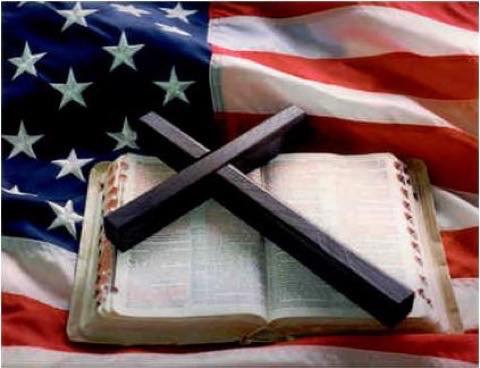
More than two decades ago, in 2004, Harvard professor Samuel Huntington warned in his book “Who Are We?” that America was facing a crisis of identity. He argued that a nation cannot remain united without a common culture, a common history, and a common understanding of itself. Remove those foundations, and a society inevitably fragments into competing tribes, interests, and identities.
Huntington pointed to the Anglo-Protestant Creed as the core of America’s unifying identity. He argued that America’s political institutions and civic ideals did not arise in a vacuum but were rooted in a culture shaped by Protestant Christianity.
If Huntington identified the foundation of America’s shared identity, educator E.D. Hirsch explained how that identity was transmitted: through a common biblical literacy that provided Americans with a shared vocabulary, history, and moral framework. Without that shared knowledge, the cultural foundations of national identity inevitably begin to erode.
The Founding Fathers were immersed in biblical imagery. Benjamin Franklin famously proposed a national seal depicting Moses at the Red Sea. The Israelites’ exodus taught lessons about liberty, tyranny, divine providence, and national purpose.
The Bible shaped how Americans understood freedom, law, covenant, human dignity, and self-government. Even those who were not orthodox Christians were influenced by the biblical worldview that permeated colonial America.
But what happens when that biblical literacy disappears?
A nation that forgets its story loses its identity. And when a people lose their identity, they become fragmented. That is precisely what Huntington warned about. Americans increasingly identify themselves by race, class, political ideology, or special interest rather than by a common national story.
The consequences of this loss of historical memory extend beyond America’s understanding of itself. They also affect America’s understanding of one of the most important sources of its cultural inheritance: the Jewish people and the biblical story of Israel.
America’s affinity for the Jewish people did not begin with the modern State of Israel. For generations, Americans viewed Jewish history through the lens of Scripture and found in Israel’s story lessons about liberty, covenant, and national purpose.
As biblical literacy declines, Israel is increasingly viewed only through a contemporary political lens, ignoring its biblical and historical foundations. Meanwhile, anti-Semitism has risen across America and the West. Certainly, anti-Semitism has many causes. Yet it is difficult to ignore the connection between a society that no longer understands the Bible and one that increasingly misunderstands the Jewish people whose history fills its pages.
The rise of anti-Semitism and the weakening of support for Israel did not occur overnight. The ground was prepared over decades as biblical literacy declined, historical memory faded, and Americans became disconnected from the sources that once helped them understand both their own identity and the identity of the Jewish people.
As America celebrates its 250th anniversary, we have an opportunity not merely to commemorate our history but to recover it. We can rediscover the biblical foundations that shaped our nation and strengthen the shared identity Huntington warned was slipping away.
The Bible is not merely a religious text but one of the foundational documents of American civilization. To understand America, one must understand the Bible. And when that understanding is lost, we lose not only part of our history but part of our identity.
Originally published at The Washington Stand
Powerful and very timely, we have lost our bearings in America. Too many liberal politicians have wanted to be like Europe. Open borders and a lack of spiritual discernment will eventually make the U.S. a weakened version of itself. We must repent and return to the Almighty. Our Christian values must be reclaimed. Morality must be returned to the public square, as well as the pulpit. We are living on borrowed time, just one bad election and we will be doomed to mediocrity. Rh
Pray – Engage – Impact
 By
By 
