
Turkey: Testing The Waters

Article below re-posted from WilliamKoenig.com

Israel strikes an air base in northwest Syria to prevent Turkish troops from deploying

Why Israel targeted a Syrian air base linked to Turkey

Netanyahu discussed the reason for the strike in a clip released on Wednesday. “We will not tolerate a Turkish military buildup extending southward. We conveyed that in every possible way.”

Now we saw that Turkey intended to establish itself at an air base farther south, close to Aleppo, and we sent a message,” he continued. “How shall I put that message? ‘Don’t.’”

The prime minister said that although the original message had been received, “apparently it wasn’t heard,” so Israel acted to ensure that the Turks “understood it better.”

We will not tolerate a Turkish military buildup extending southward,” he reiterated.

Jerusalem had given Damascus several warnings about Turkey’s military presence in the country.

———

Israel’s new Syria dilemma: Netanyahu’s Russia playbook faces ‘Turkey test’

NATIONAL AFFAIRS: Can the kind of deconfliction mechanism PM Benjamin Netanyahu established with Putin in Syria be replicated with Erdogan’s Turkey?

On Tuesday, Israel attacked the runway and storage facilities at the Abu al-Duhur air base in the Idlib province, some 60 kilometers from the Turkish border. Israel believed the base was being prepared for Turkish forces, according to foreign media reports, and a military delegation from Turkey had visited the site just hours before the attack.

On Tuesday, Israel attacked the runway and storage facilities at the Abu al-Duhur air base in the Idlib province, some 60 kilometers from the Turkish border.Israel believed the base was being prepared for Turkish forces, according to foreign media reports, and a military delegation from Turkey had visited the site just hours before the attack.

———

Turkey ‘crossed a red line’ in Syria, Israeli ambassador to US Leiter tells ‘Post’ – interview

Israeli Ambassador to the United States Yechiel Leiter told The Jerusalem Post that Israel had received clear intelligence indicating that Turkey intended to significantly expand its military presence in Syria, a move Jerusalem viewed as crossing a red line.

We are not seeking escalation or war with either Turkey or Syria. But a red line was crossed,” he said.

His comments came following Israel’s strike in Syria and subsequent criticism from both the Syrian and Turkish governments.

Let there be no mistake the world is a much dangerous place since Trump has put a leash on Israel. Israel has always feared fighting on three fronts, but they have been forced into just that scenario. Again, beating a dead horse, but why does Trump have man-crushes on despots and dictators? As I have repeatedly stated the most dangerous is Turkey, by far. Watch and pray! Rh
Buried in the defense bill: The US-Israel provision dividing Washington

by David Brody

They’re fighting about Israel again in Washington. What else is new?

Tucked deep inside Congress’ annual defense authorization bill this week is a provision that has generated fierce debate.

The debate centers on what’s known as the United States-Israel Defense Technology Cooperation Initiative. It’s included in both the House and Senate versions of the Fiscal Year 2027 National Defense Authorization Act (NDAA).

The House and Senate approach the issue somewhat differently, and the proposal has produced one of Washington’s most unusual political coalitions. The legislation would direct the Pentagon to expand cooperation with Israel in areas such as artificial intelligence, autonomous systems, missile defense, cybersecurity, biotechnology, defense manufacturing, research and development, and defense supply chains.

Supporters argue that Israel has become one of America’s most innovative military technology partners and that closer collaboration benefits U.S. national security as much as Israel’s.

They stress that this isn’t about giving Israel more military aid and that the provision inside the bill doesn’t create a joint military command or transfer operational control over U.S. forces. They say instead that by partnering with Israel, American troops will have access to cutting-edge battlefield technologies. In short, they say this is simply a commonsense effort.

Critics say hold on a minute. They complain this is a step toward permanently institutionalizing U.S.-Israel defense cooperation in ways Congress has never done before. Essentially, they argue that Congress is creating a permanent Pentagon bureaucracy whose mission would be to continually deepen military cooperation with Israel regardless of which administration occupies the White House. The critics say closely intertwining with Israel is a bridge too far.

It should be noted that the House version – at least at this point – is more restrained. It directs the Secretary of Defense to designate a Pentagon executive agent responsible for coordinating U.S.-Israel defense technology cooperation.

It also softens some of the original language by referring to the “potential integration” of Israeli technologies into American defense programs. It wouldn’t be automatic integration. In addition, the language is softer, stating that a list of coordinated activities with Israel “may” be pursued rather than “shall” be pursued.

The Senate version appears broader at this point and seems to be a more formal bilateral framework for long-term defense technology cooperation.  Normally, Israel divides Republicans and Democrats. This time, the fault line is different.

On one side are many traditional national security Republicans, pro-Israel Democrats (a dwindling group to be sure) and organizations like AIPAC. 
On the other side is a growing coalition of far-left, anti-Israel Democrats and the non-interventionist anti-Israel wing of the “America First” movement that is represented in Congress.

This side argues that Congress should not require deeper ties with Prime Minister Benjamin Netanyahu’s government at a time when there is a growing chorus of criticism directed at Israel’s conduct of the war in Gaza. 

So far, there’s been an attempt to strip the provision out of the underlying bill on the House side. Anti-Israel Republican Rep. Thomas Massie joined anti-Israel Democratic Rep. Ro Khanna in introducing an amendment to remove the provision, but the amendment was blocked before reaching the House floor, so the language currently remains in the bill.

Massie’s objections, however, come from a very different place than those of progressive Democrats. His concerns reflect the growing America First, non-interventionist wing of the Republican Party, which argues the United States should avoid permanently embedding itself in the military affairs of any foreign nation – even close allies. This contingent believes this is not traditional defense cooperation but rather an expansion of military integration. 

The progressive left echoes some of the sentiment of the America First Right, but they also worry about tying America more closely to Netanyahu’s government.

Prime Minister Netanyahu has not publicly commented in detail on the specific NDAA provisions now under debate in Congress, but his broader view of the U.S.-Israel security relationship has been consistent. While he has strongly advocated for expanding strategic cooperation between the two countries, Netanyahu has also argued in recent years that Israel should gradually reduce its dependence on American military aid.

Following the October 7 attacks, he reiterated that Israel ultimately must be able to defend itself by itself, and has suggested that as Israel’s economy and defense industry continue to grow, the country should work toward greater self-sufficiency rather than relying indefinitely on U.S. assistance.

What this current debate over the measure shows is that Israel is not going to escape close scrutiny by those in Congress. While the majority still supports Israel, the growing faction of far-left Democrats and woke right America-first conservatives create a substantial problem for Israel. It comes at the worst possible time.

I am a total supporter of this bill. The alliance between Israel and the U.S. government is one that benefits us even more than Israel. They buy our weaponry, enhance many of our military systems and give us valuable intel that we could not attain without their help. Rh

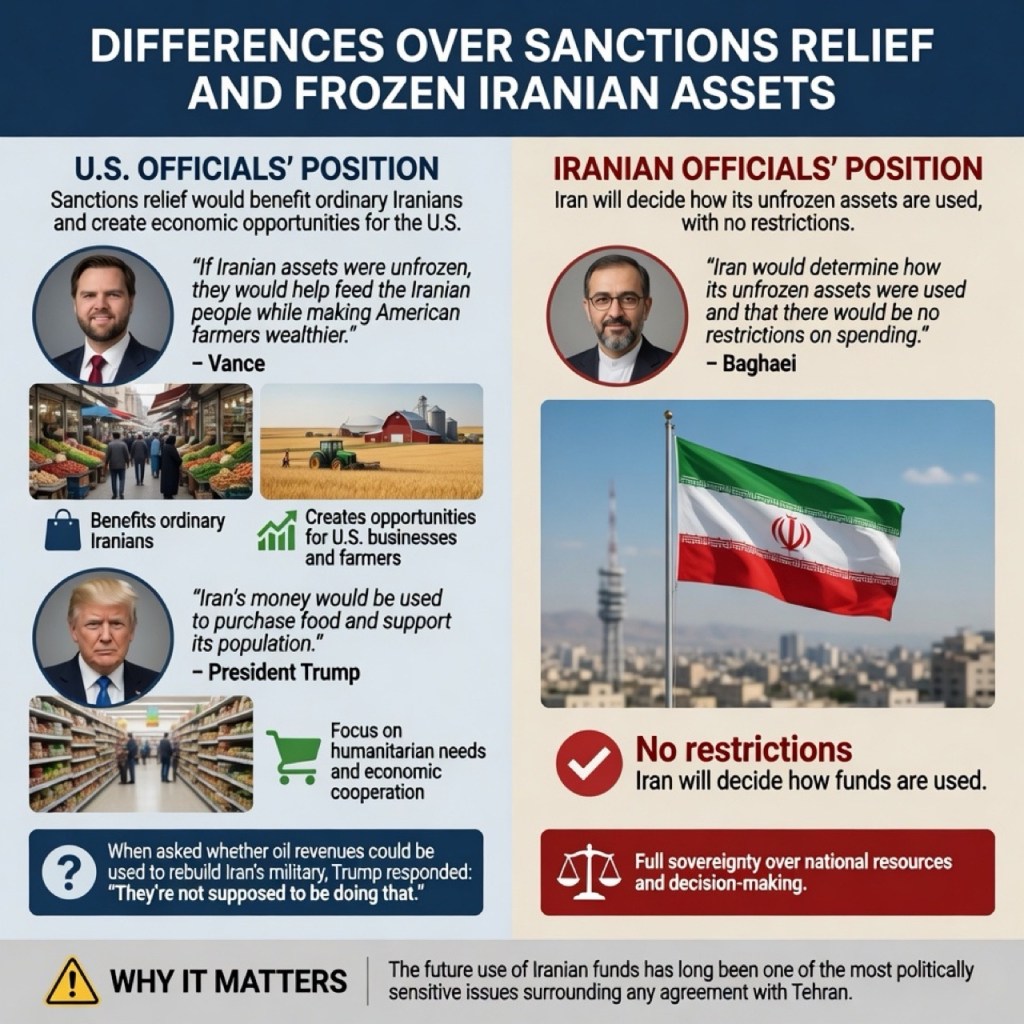
Who Do You Believe??

The future use of Iranian funds has long been one of the most politically sensitive issues surrounding any agreement with Tehran.

Who do you believe, that is the question. I am not calling Vance and Trump liars, but there is no way the Iranian regime is going to do what Vance said they would do.

Even if they did distribute some of the money to be used for food, that would only allow them to divert other monies to re-claim their missile program or their nuclear ambitions.

If we give him the benefit of the doubt and say Vance truly believes the Iranians, it tells me he is a novice at best, and a fool at worst. Harsh words maybe, but accurate. So do we have a deal or is this just propaganda on both sides? Or are the Iranians lying, and if they are we need to continue the war.

One final note, in the Muslim faith they have a word to describe the act of deceiving or lying to a mon Muslim. It is called “Taqiyya.” You see the Islamist use their faith as military action, not as a true religion. So there we have it, whatever is finally agreed upon will never be what Iran will do. Guarantee that for a fact.

Forty-seven years of failure and now we are so close to total victory. Mr. President, finish the job. Demand complete and total surrender. On our terms. Rh

Epilogue: I will have more at another time on Vance, he has proven himself not ready for the big stage!

Update:

The regime doesn’t change its spots, and as Secretary of State Marco Rubio laid out this past weekend, the regime in Tehran has, and will continue to be, the driving force behind Middle East terror and turmoil.

“Every problem in the Middle East tracks back to Iran,” Rubio stressed. “Hezbollah—Iran. Shia militias that are destroying and threatening Iraq—Iran. Hamas—Iran. The Houthis—Iran. Assad when he was in Syria—Iran. Everywhere you turn, they’re behind all of it.”

“They are a destabilizing, dangerous, evil force that had to be dealt with,” he emphasized. “They have to be weakened.” Quote from Secretary Marco Rubio

Inside Israel Analysis

Forwarded from Amir Tsarfati, a Messianic Jew, author and former IDF soldier. Great take on the supposed deal with Iran. Enjoy the read. Rh

After several hours of confusion and uncertainty, it’s time to bring some order to the situation.

What exactly did Trump agree to?

The agreement rests on two very lean principles:

“The Strait of Hormuz must remain open to free navigation, and Iran must not possess nuclear weapons.”

Trump has insisted in nearly every other post that Iran will not be allowed to obtain nuclear weapons, while simultaneously pushing to keep the Strait of Hormuz open to unrestricted maritime traffic at any cost.

But why was Trump so eager to reach such a minimal agreement? Why did he pressure Israel not to interfere, even at the cost of merging the various fronts and exposing soldiers to greater danger? Why did J.D. Vance, who has opposed military intervention, suddenly move to the forefront while Rubio faded into the background? And why has no one managed to offer a convincing explanation beyond references to the World Cup, birthdays, the midterm elections, and other superficial reasons for this apparent obsession?

Most importantly: What does Trump intend to do with Iran during the 60-day ceasefire he has effectively bought for himself?

It is possible – and I emphasize that this is an informed analysis of events, not verified information—that the answers lie in what took place in Beijing during the visit held last month (May 13–15, 2026).

Trump arrived in China after not meeting President Xi for nine years. Over the previous year, he had reshaped the global economic landscape through tariffs, supply chains, and trade routes in an effort to reduce China’s dominance and push it into a corner. He had even postponed the visit for a month because of the operation against Iran.

However, Trump arrived in Beijing in a weaker position than he had planned. He had hoped to come as the victor over Iran and force China to accept new trade oversight mechanisms, agreements on rare earth minerals, and AI cooperation that would secure American leadership of the global economy.

But the Chinese did not cooperate.

Instead, they threatened escalation and even the possibility of a wider global conflict, particularly through pressure on Taiwan. They were also deeply concerned about the loss of cheap Iranian oil supplies that the United States had disrupted.

As is often the case between great powers, the talks did not collapse. Some significant deals were reached – most notably Boeing’s sale of 200 aircraft to China. But the joint statement was remarkably brief, containing only one key sentence:

“The Strait of Hormuz must remain open to free navigation, and Iran must not possess nuclear weapons.”

Those are precisely the same principles that now define the agreement with Iran.

Trump is persistent and determined to continue building what he sees as a new global order under American economic leadership. After encountering Chinese resistance to broader agreements, he may have settled for a simpler bargain: oil in exchange for a non-nuclear Iran.

Like a businessman honoring a deal, he returned determined to fulfill his part of the bargain.

From that perspective, everything became acceptable: pressuring Israel to lower its profile, allowing Qataris, Pakistanis, and Saudis to serve as mediators, and bringing in J.D. Vance – whom the Iranians and Pakistanis reportedly trust more than Rubio or Witkoff. The overriding objective was simply to secure signatures and an agreement.

If this theory is correct—and if Trump did not simply turn against Israel in favor of Qatar and Pakistan – then Iran itself is not his primary concern, despite the fact that it allegedly tried to assassinate him only two years ago.

Instead, he will use these two months to complete his side of the understanding with China: ensure that Iran remains non-nuclear, after which Israel, America’s exemplary ally, will return to the position it has occupied over the past year and a half.

As for a formal nuclear agreement: if it succeeds, all the better. By Amir Tsarfati

Deal Was Made: A Bad Deal Uninforceable

President Trump: The Deal with the Islamic Republic of Iran is now complete. Congratulations to all! I hereby fully authorize the toll free opening of the Strait of Hormuz, and, simultaneously herewith, authorize the immediate removal of the United States Naval blockade. Ships of the World, start your engines. Let the oil flow! President DONALD J. TRUMP

As Churchill wrote to Lord Moyne right before the Munich agreement:

“We seem to be very near the bleak choice between War and Shame. My feeling is that we shall choose Shame, and then have War thrown in a little later on even more adverse terms than at present.”

Americas chose shame

War will come a little later Amir Tsarfati

For whatever reason, Trump cowered. Mark my words, this war is not over. The West is ceding democracies all across Europe and even in the U.S. The rise of Islam is here. J. D Vance, Kushner and Witkoff are the instigators of this defeat. The art of a bad deal!

Very sad day in America. Rh

War Update

Trump capitulations on a fantasy deal with Iran has emboldened them to re start the missile launches toward Israel. Once again how does one make a deal with terrorist? This should have been finished. Rh

Israel’s finance minister Smotrich intends to demand in this morning’s security cabinet meeting to turn the equation that Iran tried to create between itself and Lebanon on its head and focus mainly on a strong response in Lebanon. For every Iranian missile, dozens of buildings in Dahieh should be taken down.

According to his equation, two or three hundred buildings in Beirut should have fallen last night. This is much easier, more accessible, and more effective than a response in Iran, including taking advantage of the opportunity with long-term gains for the security of northern residents, like the “money plow” under which the IDF destroys the contact villages in southern Lebanon, so that Hezbollah will beg the Iranians to stop.

Conversely, this could also bring the Iranians to be flexible in negotiations with the Americans, after a month and a half of their insistence and American backing down. In such a case, Trump would also appreciate it, and Israel would again earn points with him for initiative and boldness that change reality. Trump always likes to take credit for others’ successes, and this is not bad for Israel.

Smotrich suggests saving the armaments and efforts against Iran for the moment when we decide to go after the energy infrastructures that will paralyze Iran and cripple its economy. In his opinion, it is a shame to waste capabilities on exchanges of blows within standard equations. In cost-benefit tests, strikes in nearby Lebanon are much more efficient than strikes in distant Iran that are not part of a comprehensive move where you go all the way without limitations.

An interesting thesis. Even more interesting if Netanyahu adopts it or if he has another ace up his sleeve.

(Amit Segal)

Deja Vu All Over Again

I am in the Oval Office at the White House where we just had a very good call with President Mohammed bin Salman Al Saud, of Saudi Arabia, Mohammed bin Zayed Al Nahyan, of The United Arab Emirates, Emir Tamim bin Hamad bin Khalifa Al Thani, Prime Minister Mohammed bin Abdulrahman bin Jassim bin Jaber Al Thani, and Minister Ali al-Thawadi, of Qatar, Field Marshal Syed Asim Munir Ahmed Shah, of Pakistan, President Recep Tayyip Erdoğan, of Türkiye, President Abdel Fattah El-Sisi, of Egypt, King Abdullah II, of Jordan, and King Hamad bin Isa Al Khalifa, of Bahrain, concerning the Islamic Republic of Iran, and all things related to a Memorandum of Understanding pertaining to PEACE. An Agreement has been largely negotiated, subject to finalization between the United States of America, the Islamic Republic of Iran, and the various other Countries, as listed. Separately, I had a call with Prime Minister Bibi Netanyahu, of Israel, which, likewise, went very well. Final aspects and details of the Deal are currently being discussed, and will be announced shortly. In addition to many other elements of the Agreement, the Strait of Hormuz will be opened. Thank you for your attention to this matter!

President DONALD J. TRUMP

Mark Dubowitz, the chief executive of FDD, a conservative Washington, D.C.-based nonpartisan policy institute:

Epic Fury lasted 40 days.

The ceasefire has now lasted 60.

The U.S. and Israeli militaries won the war. But if the reported terms are accurate, the regime is now winning the ceasefire.

Another 60-day extension would only deepen Tehran’s advantage.

Ok so what we have is a preliminary agreement? An agreement largely been negotiated? Remember the Gaza peace deal of the century? Israel was within a couple of weeks of total victory, and Trump jumps in signs a ceasefire and demands Hamas give up their weapons. They never did. Ok now we start a war and are within a couple of weeks of finishing off Iran, we stop and start negotiating? We just left the dissidents in Iran up a creek without a paddle. Will this deal go the way of the Gaza ceasefire? Yep. I just don’t understand, please make me understand it. As long as Iran still have capabilities to make and deploy nuclear weapons, the won. They went toe to toe to Big Satan and won.

I feel the worst for Israel. They will have to deal with them in the near future. Mark my words, this isn’t over, in fact the fighting may have to begin again. When it does I hope Trump has learned his lesson and takes care of business. As of now back to status quo. Rh

Update:

Details of the signed MOU:

– Strait of Hormuz will fully reopen

– Iran will not charge transit fees

– US won’t pay any money to Iran

– Sanction relief on Iranian oil

– Lebanon is part of the ceasefire

– 60 days to negotiate nuclear issues

Per Amir Tsarfati

The American Rebellion Against AI Is Gaining Steam

By Amrith Ramkumar,  Katherine Blunt and Lindsay Ellis

The only thing growing faster than the artificial-intelligence industry may be Americans’ negative feelings about it—as former Google Chief Executive Eric Schmidt saw on Friday.

Delivering a commencement address at the University of Arizona, Schmidt told students the “technological transformation” wrought by artificial intelligence will be “larger, faster and more consequential than what came before.” Like some other graduation speakers mentioning AI, Schmidt was met with a chorus of boos.

In one poll after another in recent weeks, respondents have overwhelmingly voiced concerns about AI, a challenge to claims by industry executives that their technology would gain popularity by improving people’s lives.

For full article: The Wall Street Journal

Just recently I read another article that bemoaned the fact that AI would not only wreck havoc with “white” collar jobs, but also “blue” collar jobs as well. My main issue with AI is the fact we don’t fully, maybe we do in some high and mighty circles, understand the rapid growth of the industry. Many who pioneered AI are sounding the alarm. But, it may be too late to put the evil genius back into the bottle. Especially when it has a mind of its own. Rh

Movement With Iran

Reports that the U.S. and Iran are at the closest point to an agreement since the war began.

• The naval blockade by the US and Iran will be gradually lifted during the detailed negotiation period.

• The US will commit in the memorandum of understanding to gradually remove sanctions and release tens of billions of dollars from freezing.

• Negotiations are still ongoing regarding the duration of the uranium enrichment freeze. Three sources said the freeze will last at least 12 years, and one source estimated the final result will be 15 years. Additionally, the US wants to include a clause in the agreement stating that any Iranian violation regarding uranium enrichment will extend the freeze period.

• Two sources claimed that Iran will agree to remove the highly enriched uranium in its possession from the country.

• The United States expects to receive Iran’s response within the next 48 hours on several key points in the draft framework agreement.

Trump to PBS: Trump to PBS network: It is possible that we will reach a deal before my visit to China next week. There is a good chance to end the war with Iran. I don’t think I will send Witkoff and Kushner for talks.

More from Trump to PBS: The enriched uranium will be transferred to the US as part of the deal. Iran will not use underground facilities. If there is no agreement, we will bomb them to hell

IMO – it will never happen. Iran’s leadership is fractured. Hardliners only want delay, the more moderate faction does want some type of deal. What will Trump do? Who knows, Mr preference is take ‘em out. Rh

Update:

Bottom line:

Once again, the political level of the Islamic Republic is making promises to the Americans that the military level – which is de facto ruling the country – is not in agreement with.

Netanyahu

Netanyahu

By Jim Fletcher

Below is a powerful tribute to a roaring lion for the nation of Israel. Some love him, most hate or despise him. He and Trump, (IMO) are much alike. Raised for such a time as this, together they have proved a valiant and resolute pair of compatriots against the evils of the day in the Middle East, especially there firm conviction that Iran must be de-clawed. Never count either one out. Cheers and God’s best to them both. Rh

I well remember asking a new Israeli friend in 1996 how to pronounce the name of a rising politician, one running for prime minister of Israel against the old lion, Shimon Peres.

The new lion would do quite well for himself.

Benjamin Netanyahu, against all odds, beat Peres in 1996 and though he lost to the hapless Ehud Barak three years later, he re-emerged later to become Israel’s longest-serving PM. 

(When I say “hapless,” I mean that Barak was as a politician. As a commander within the IDF’s elite counter-terrorism unit, Barak was truly elite. Israel’s fighters-turned-politicians often do maddening things once in office. Netanyahu himself has bucked that trend and has served with distinction.)

Netanyahu was hated from the beginning, although he’s always had a strong base within the Likud Party (somewhat akin to our Republicans). Raised on a strong diet of Zionism from Benzion and Cela, he and his brothers have been devoted lions for the state of Israel. I remember in Bibi’s book, A Durable Peace, he described a training maneuver that took his unit through the Negev Desert, emerging at Masada one night. Sweating, breathing hard as he looked at the ancient fortress, Netanyahu felt a real link to his ancestors. This is the essence of Zionism and has served him well as he navigated evil leaders like Arafat, Clinton, and all UN chiefs. 

This week, I thought he got a nice tribute via X, as @liberallikudnik wrote:

“Begin grew old and weary and handed over all of Sinai to Egypt. Rabin grew old and weary and brought armed terrorists into the heart of the country. Sharon grew old and weary and turned Gaza into Judenrein and a terrorist state. Netanyahu in their age, a hero like a lion, full of vigor, building in Judea and Samaria, leading the IDF back to Gaza, to Lebanon and Syria, and eliminating the regime of evil in Iran. May he be healthy.”

True enough. Although I take exception to the partial description of Menachem Begin, a truly elite PM for Israel. As the winner of the premiership in 1977, leading Likud, Begin has arguably been Israel’s most religious prime minister. He was a great man. Yes, he tired at the end, but his mind and body were spent fighting as a Zionist. May his memory be a blessing.

I would say Yitzhak Rabin, as perhaps Israel’s least religious leader, made some fundamental diplomatic errors, yet. Sharon inexplicably emptied Gaza of Jews, but I suspect that had a lot to do with intense pressure from the George Bush gang. Among the weakest Israeli PMs—if you can call Naftali Bennett’s and Yair Lapid’s five minutes in office actual leaders—are those two, ideological foes that still came together in their hatred of Netanyahu.

New Israeli elections will emerge this fall and as usual, like clockwork, Netanyahu’s political obituary is being polished up as we speak. It can be added to the dozens more than have come before. It’s a bit like Oklahoma and Texas, or vice versa, not having a chance against the other in the Cotton Bowl. Then…the inevitable upset.

Benjamin Netanyahu has been criticized, heavily, by literally everyone. He has a polarizing personality, but I would argue not of his own making. I haven’t always liked his decisions, but everyone does that. I will go to my grave believing that he is much more the young man that sat around the family dinner table in the Old Katamon neighborhood in Jerusalem. As I’ve written before, I knew the old man the last decade he lived, and a couple times walked a few blocks over to gaze on the sublime scene of Jerusalem’s Old City in the moonlight. My wonderful conversations with Benzion make it clear to me all three Netanyahu boys will take Zion into their hearts for the duration. All three served in the same unit, Sayeret Matkal. 

At present, there is no one fit to tie Netanyahu’s shoelaces among their political echelon. 

Here’s to King Bibi!